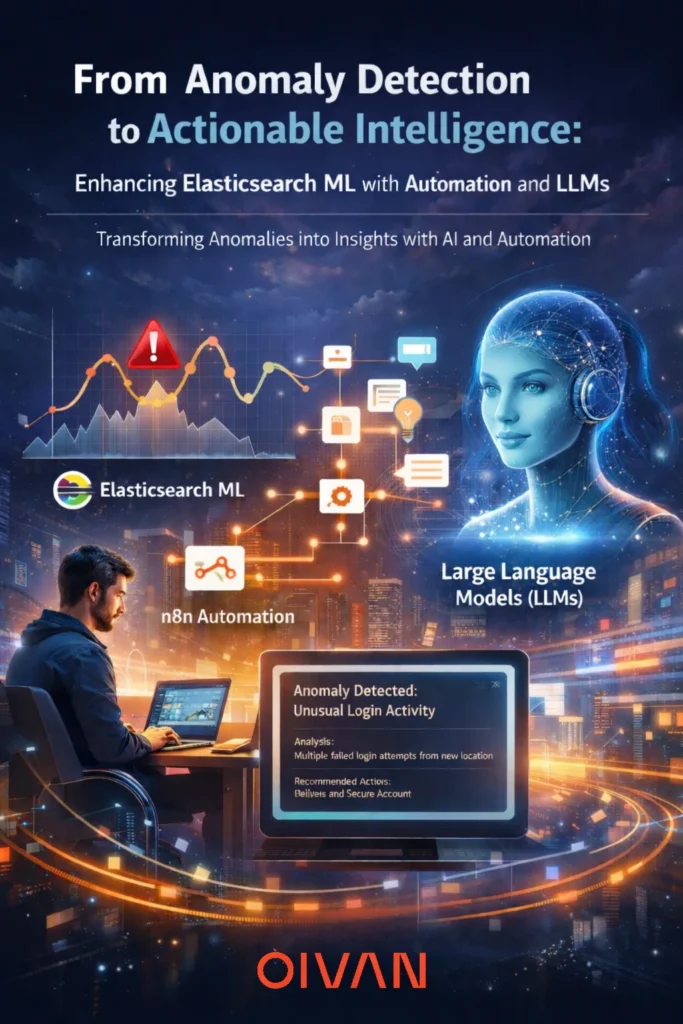
From Anomaly Detection to Actionable Intelligence: Enhancing Elasticsearch ML with Automation and LLMs

Modern monitoring systems generate enormous volumes of telemetry data and anomaly alerts. While anomaly detection has become increasingly sophisticated, identifying an anomaly is only half the battle. The real challenge lies in interpretation — understanding why something happened and what to do next.

At Oivan, we explored this gap through an engineering initiative focused on transforming raw anomaly signals into meaningful, actionable insights. By integrating Elasticsearch Machine Learning (ML), n8n automation, and Large Language Models (LLMs), we built a system that moves beyond detection toward intelligent, contextual alerting.

Oivan’s Infrastructure Engineer Mohamed Rahees walks us through the challenge and our solution.

Blog Highlights

Category

Date Published

Elasticsearch ML with Automation and LLMs
The Challenge: Detection Without Context

Elasticsearch ML excels at identifying unusual patterns in system behavior. It provides anomaly scores, highlights influencers, and detects deviations effectively. However, its outputs still require significant manual effort:

  • Correlating logs across systems
  • Interpreting anomaly significance
  • Determining operational impact


In fast-paced environments, these manual steps slow down response times and increase cognitive load on engineering and operations teams.

The key question became: How can we turn anomaly detection into immediate, contextual understanding — without human intervention?

Objective: Automating Insight Generation

Our goal was to create a system that automatically converts anomaly signals into structured, human-readable insights enriched with relevant context.

We focused on:

  • Eliminating manual log investigation after detection
  • Automatically generating explanations for anomalies
  • Delivering alerts in a clear, structured format
  • Accelerating response and decision-making cycles


Architecture Overview

The solution combines four core components:

  1. Elasticsearch ML — Detects anomalies in real time
  2. n8n Workflow Engine — Orchestrates data extraction and enrichment
  3. LLM-based Analysis — Interprets anomalies and generates explanations
  4. Alert Delivery Layer — Sends structured insights via messaging/webhooks


How It Works

The workflow follows a seamless, automated pipeline:

  1. Anomaly Detection: Elasticsearch ML flags unusual behavior based on learned patterns
  2. Automated Extraction: n8n retrieves anomaly details, including scores and influencers
  3. Context Enrichment: Relevant logs and supporting data are fetched automatically
  4. LLM Interpretation: The anomaly and its context are analyzed to generate a meaningful explanation
  5. Structured Alert Delivery: A fully enriched insight is delivered to operational teams in real time


From Raw Signals to Operational Intelligence

The transformation is best illustrated through an example:


Before: “Anomaly score: 82 — spike detected.”


After: “Significant deviation detected over a short interval. Behavior is consistent with unusual request activity. Enriched logs indicate repeated access attempts. Recommend reviewing network security logs for confirmation.”


Instead of requiring investigation, the alert itself becomes a starting point for action.


Output Structure

Each generated insight includes:

  • Timestamp and anomaly attributes
  • Relevant log samples or references
  • Explanation of potential root cause
  • Suggested validation or next steps


Impact and Benefits

This approach delivers immediate operational value:

  • Reduced analysis time — Faster understanding of anomalies
  • Improved clarity — Context-rich, human-readable alerts
  • Lower cognitive load — Less manual investigation required
  • Faster response cycles — Teams can act sooner and with confidence
  • Scalable intelligence — Supports high-volume monitoring environments

Toward Autonomous Monitoring

This implementation represents a shift in how monitoring systems are used. Rather than acting as signal generators, they evolve into operational intelligence engines.

By combining machine learning with workflow automation and AI-driven interpretation, we bridge the gap between detection and action.

Importantly, this approach does not replace human expertise — it amplifies it. Engineers and analysts can focus on decision-making rather than data gathering and initial interpretation.

Technology Stack

  • Elasticsearch Machine Learning
  • n8n workflow automation
  • Large Language Models (LLMs)
  • Webhook-based alert delivery


Conclusion

As systems grow more complex, the ability to interpret anomalies quickly becomes as important as detecting them. By enriching anomaly detection with automation and AI-driven context, organizations can move from reactive monitoring to proactive, intelligent operations.

At Oivan, this initiative demonstrates how thoughtful integration of existing technologies can significantly enhance operational efficiency — turning raw data into actionable insight at scale.

Contact Our

Team

By submitting this form, you agree to our Privacy Policy.