From Cloud Sovereignty to Cloud Resilience in Saudi Arabia

By Arun Natarajan, Chief Delivery Officer, Oivan & Tapio Äijälä, Chief Strategy Officer, Oivan

Earlier this summer, Deloitte’s Tariq M. Ajmal gave Asharq Al-Awsat a great interview about technology resilience and what he calls the era of “complex technology crises.” Worth a read, even if the original article is in Arabic.

One point especially stood out: Data sovereignty alone is not enough. Resilience also means being able to keep critical services running when infrastructure, connectivity or even an entire technology provider experiences a major disruption.

Blog Highlights

Category

Date Published

Cloud Portability and Resilience

Cloud portability and resilience became even more relevant topic during LEAP in Riyadh at the start of September.

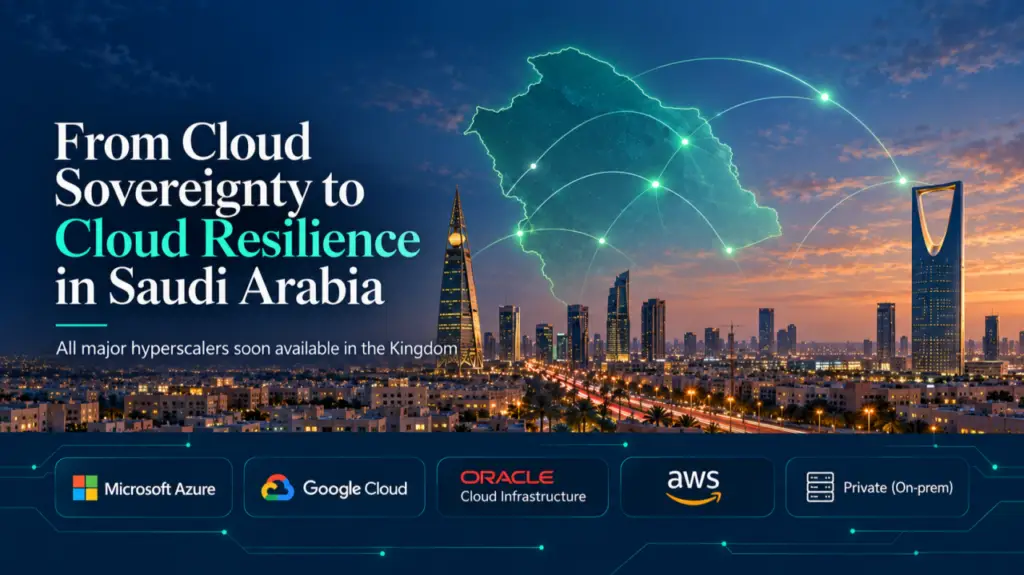
Microsoft confirmed that its Saudi Arabia East cloud region will become available in November 2026, while AWS announced that its Saudi Arabia region is on track to launch in December. Together with the already established Google Cloud, Oracle, Alibaba and Huawei this means Saudi organizations will soon have access to all major hyperscalers locally.

That is great news for data residency and cloud adoption. But we believe the bigger opportunity is cloud portability and resilience.

For critical digital services, organizations should increasingly ask:

If a critical cloud service, region or provider became unavailable, how quickly could we actually recover somewhere else?

The answer does not mean running everything simultaneously across several clouds. In many cases, that would simply add unnecessary cost and complexity.

Instead, it means understanding where critical dependencies exist and designing systems so that unnecessary lock-in does not become a business continuity risk.

Kubernetes and Containerized Applications

This is where technology choices become strategic.

Using Kubernetes and containerized applications, infrastructure as code, portable CI/CD pipelines, common observability, well-designed identity architecture and open technologies can make it significantly easier to move or recover workloads across cloud, private cloud and on-premise environments.

The real challenge is often not compute portability, but dependency portability. At Oivan, this is an area we have worked with for years.

Our teams build and operate environments across AWS, Azure, Google Cloud, private cloud and on-premise infrastructure, while technologies such as SUSE Rancher and GitLab help us create a more consistent, secure and portable technology layer across those environments.

From container orchestration and DevSecOps pipelines to software supply-chain security and open database platforms, these technologies can reduce dependencies on individual infrastructure providers. Combining this with our DevSecOps, cybersecurity and infrastructure expertise allows us to look at resilience across the whole technology stack – from applications and data to platforms and infrastructure, rather than focusing only on the cloud provider.

Choice and Portability

The goal is not multi-cloud for the sake of multi-cloud.

It is to give organizations choice, portability and a realistic recovery path, while maintaining Saudi data sovereignty, security and regulatory requirements.

As Saudi Arabia’s cloud ecosystem enters its next phase, the discussion should increasingly move from:

“Is our data hosted in Saudi Arabia?”

to:

“How resilient are our critical digital services if something major goes wrong?”

For organizations operating mission-critical digital platforms in Saudi Arabia, that leads to a very practical question:

If your primary cloud went completely offline tomorrow, which services could you recover, where could you recover them and how quickly?

This is exactly the type of resilience assessment and architecture discussion we are happy to support at Oivan.

Contact Our

Team

By submitting this form, you agree to our Privacy Policy
This site is protected by reCAPTCHA.