
Why File Storage Has Become a Data Governance Decision, Not Just an IT Choice

Security in file storage is a critical topic. File security is about classifying, protecting, and controlling access to the data and its storage, in most cases. Every organization has diverse data storage and sharing requirements. Choosing the right solution is a challenge.

Today file storage is no longer only about where documents live. It is also about which data can safely be used by AI systems, which documents may be indexed, which files can be used for retrieval-augmented generation, and how organizations prevent sensitive information from leaking into external AI tools.

Based on our experience in setting up file sharing and collaboration platforms for clients who deal with highly confidential data, we come up with the top features to consider while designing a solution for your organization’s file sharing and collaboration needs.
 

Blog Highlights

Category

Date Published

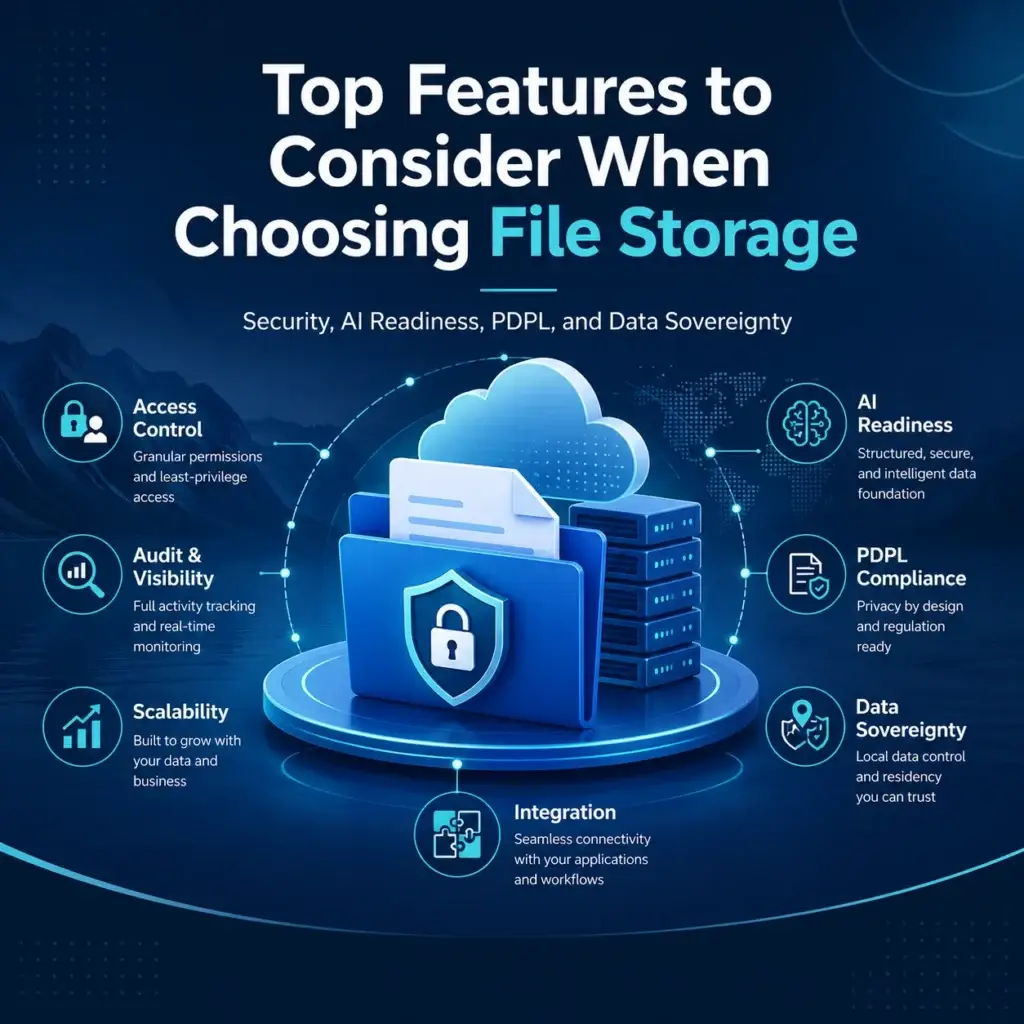
Top Features to Consider When Choosing File Storage
1. Sovereign and AI-ready Infrastructure

With self-managed file sharing and collaboration platforms, data is in your control. It can be hosted in the cloud, on local premises, or in a sovereign cloud environment.

These days, many organizations and governments require data to stay within their infrastructure, jurisdiction, or country. This is especially relevant in regulated markets, where privacy laws, PDPL, and data sovereignty requirements influence how data platforms are designed.

Although self-hosted systems have administrative requirements, in many cases they are no longer just an option. They are a business and compliance requirement.

Open source adds value through transparency and source code availability. Source code access makes it easier to customize and extend solutions according to local organizational requirements.

It also helps organizations better understand how their data is handled, which becomes increasingly important when integrating file storage with automation, analytics, or AI-enabled tools.

2. Access Governance for People, Systems and AI

Control of data is crucial. Generally, it is about where information is stored, how it is managed, and who or what can access it.

Organizations should be able to define access control for files and directories based on different criteria, such as users, groups, roles, and locations.

For example, an organization policy file may be shared so every employee has read permission, while only policy owners have write privileges.

In many cases, organizations need to share files with external users or entities. The file-sharing solution should support a simple and secure method for sharing files externally, while protecting those shares with proper authentication, expiration dates, and access controls.

Today, access control should also consider connected systems and AI-enabled workflows. Organizations need to know not only which people can access a file, but also which applications, integrations, or AI tools can read, index, summarize, or process it.

All this makes least-privilege access, role-based permissions, single sign-on, multi-factor authentication, external sharing controls, time-limited links, and detailed audit trails more important than ever.

3. Security Visibility and Auditability

The system must have common security standards in place. These include compliance support, data policy enforcement, user management, and auditing capabilities.

Evaluate auditing and logging capabilities to ensure the solution can be integrated with your organization’s security visibility tools.

Also consider data encryption based on your requirements. The more complex the encryption methods, the more carefully you need to evaluate their impact on collaboration features.
4. Scalability Beyond Storage Capacity

In the past, scalability often meant having enough storage capacity for growing teams and larger files. Today, scalability should be considered from all dimensions: architecture, components, software dependencies, security, governance, and future AI use cases.

As the amount of data grows, organizations need access policies, audit logs, backup, disaster recovery, classification, search, and AI indexing to scale in a secure and manageable way.

Start right from the beginning to ensure that the secure file-sharing solution supports your future requirements. Unlike commercial file sharing solutions, storage scalability in self-managed environments depends on your infrastructure capacity.

5. Collaboration and Integration

A file storage platform rarely works alone. It usually connects to identity management, collaboration tools, email, office documents, workflow automation, security monitoring, backup systems, and increasingly, AI-powered services.

Each integration should be evaluated not only for convenience, but also for governance.

Where does the integrated tool process data? What does it log? Does it support data residency requirements? Can access be controlled centrally? Does it introduce new AI-related data exposure?

There is a possibility that the most your organization’s requirements are already available in an open-source solution, or that the solution can be enhanced to support your needs.

The growing number of integration partners around open-source solutions makes it possible to enrich features. Some of the most requested features include communication, task management, whiteboards, document collaboration, and similar capabilities.

However, more dependencies can make it challenging to keep the system secure and scalable.

Building Trusted Digital Services Starts With Governed Data

For organizations operating in regulated markets, including Saudi Arabia, file storage and collaboration solutions need to be designed and architected around privacy, PDPL, data sovereignty, security, and future AI use cases from the beginning.

At Oivan, we help our customers to choose the appropriate file-sharing and collaboration solutions, ranging from small organizations to big ones with Petabytes of data.

We have done large-scale deployments with Nextcloud file sharing and collaboration platforms and are actively engaged in enhancing the solution’s features.

Contact Our

Team

By submitting this form, you agree to our Privacy Policy.